
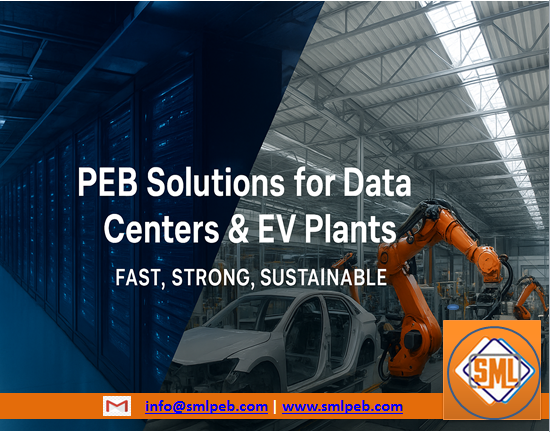
Data Centers & EV Manufacturing PEBs: Building the Future with Saxena Marine Tech Pvt. Ltd.
How Saxena Marine Tech Pvt Ltd is leading the way in building earthquake-resistant Pre-Engineered Buildings (PEBs) for safety and durability in seismic zones like Delhi NCR.
Design PEBs for data centers & EV plants with SML. Engineered for heavy loads, energy efficiency and faster project delivery.
Introduction
The world is undergoing a technological revolution. Two industries stand out as the fastest-growing pillars of this transformation: data centers and electric vehicle (EV) manufacturing plants. Data centers are the backbone of digital economies, while EV plants represent the future of mobility and clean energy. Both are capital-intensive, engineering-heavy facilities that demand speed, precision and scalability.
Pre-Engineered Buildings (PEBs) have emerged as the preferred building system for these high-performance assets because they combine factory-controlled fabrication, rapid on-site erection and exceptional structural efficiency. For owners, developers and EPCs, PEBs convert time saved into faster commissioning and earlier revenues. For operators, they deliver durable shells with superior thermal performance and easier long-term maintenance.
At Saxena Marine Tech Pvt. Ltd. (SML), we specialize in designing and delivering custom PEB solutions engineered precisely for the unique loads, process layouts and sustainability targets of data centers and EV manufacturing facilities. This guide explains the market context, the engineering that matters, and how SML de-risks delivery while improving total cost of ownership (TCO).
1) The Booming Demand for Data Centers and EV Manufacturing Plants
- Data centers: Cloud adoption, AI/ML workloads, 5G densification and data localization policies are pushing unprecedented capacity creation. Hyperscale and colocation providers need large, repeatable shells with generous clear heights, rooftop space for HVAC and photovoltaics, and floors designed for heavy live loads.
• EV manufacturing: National targets for electrification and supply-chain localization are accelerating gigafactories and EV assembly plants. These facilities host heavy stamping machines, robotic cells, conveyorized lines, battery assembly rooms and hazardous-area storage—each with distinct structural and envelope needs.
Common denominator: both asset types reward speed-to-market and energy efficiency. PEBs excel on both counts.
2) Why PEBs Are Ideal for Data Centers & EV Plants
- Up to 30–50% faster build cycles versus conventional RCC due to off-site fabrication and parallel workflows.
- Column-free spans of 30–100+ meters enabling efficient equipment layouts, AGV aisles and material flow.
- High load paths with optimized built-up members, castellated beams and bracing schemes for cranes/HVAC/solar.
- Superior envelope performance with PUF/Rockwool panels, air-tight details and daylighting options.
- Ease of expansion by adding bays or mezzanines; minimal disruption to live operations.
- Lower lifecycle costs through corrosion-resistant finishes, standardized details and simpler maintenance.
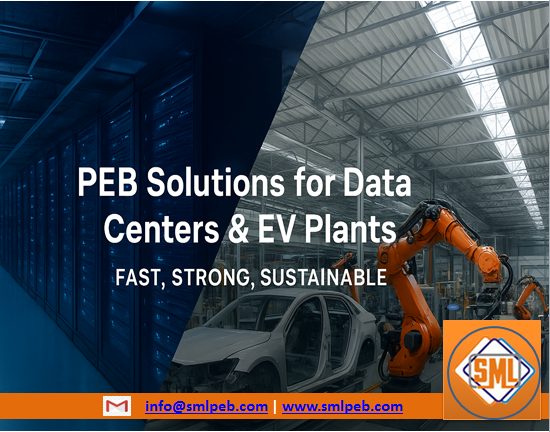
3) Engineering Considerations for Data Center PEBs
Designing a data center shell is a precision exercise. SML’s engineering approach focuses on capacity, availability and risk management:
- Heavy Live Loads & Floor Systems: Equipment racks, battery systems and raised floors demand floors designed for higher live loads and minimal deflection. Roofs must carry large AHUs, dry coolers or cooling towers with walkable maintenance zones.
- Thermal Performance: High-R roofing and wall systems (PUF or Rockwool), thermal breaks at secondary members, vapor barriers and air-tightness details reduce cooling loads and protect IT uptime.
- Fire & Life Safety: Fire-rated panels, protected steel (intumescent/encasement as applicable), compartmentation around battery rooms and cable paths, and compliant egress routes.
- Seismic/Wind/Cyclone Design: Site-specific response spectra, ductile detailing and robust bracing ensure resilience. Roof equipment frames are checked for accelerations and anchorage.
- MEP Coordination: Early BIM coordination for penetrations, cable trays, chilled-water piping, ladders and roof curb details avoids clashes and rework.
- EMI/EMC & Acoustic Concerns: Where required, panel layering and acoustic treatments are integrated without sacrificing structural efficiency.
4) Engineering Considerations for EV Manufacturing PEBs
EV plants combine diverse spaces—press shops, body shops, battery assembly, paint shops, testing tracks and warehousing. SML tailors steel geometry and envelope performance across zones:
- Long Clear Spans & Grid Flexibility: 30–50 m clear spans with optimized bay spacing support conveyors, AGVs and overhead lines; provision for future line reconfiguration.
- Point & Line Loads: Local stiffening/plate inserts at equipment foundations and mezzanine interface points distribute concentrated loads efficiently.
- Crane Systems: Top-running EOT cranes for heavy components with lateral surge checks on runway beams and end-car stops.
- Environmental Controls: High-performance insulation, controlled ventilation, filtration and humidity control for battery rooms; explosion-relief panels where required.
- ESD & Safety: Anti-static flooring zones, hazardous-area classifications and protected cable routing integrated into the structural scheme.
- Roof Utility Planning: Dedicated corridors for solar PV, skylights and roof-monitor ventilation with non-penetrative mounting on standing-seam systems.
5) PEB vs RCC for High-Tech Facilities
A quick comparison of what matters most to data center and EV plant owners/operators:
Criteria | PEB (Steel) | RCC (Concrete) |
Construction Speed | 4–8 months with parallel fabrication/erection | 12–18 months; sequential and weather-sensitive |
Flexibility/Expansion | Add bays/mezzanines with minimal downtime | Difficult; structural modifications are slow/costly |
Clear Spans | 30–100+ m achievable | Typically limited without deep transfer systems |
Heavy Equipment Loads | Optimized built-up sections and localized stiffening | Heavier self-weight; thicker members/foundations |
Energy Efficiency | High with insulated panels and air-tight details | Retrofits often needed for comparable performance |
Lifecycle Costs | Lower O&M; corrosion-resistant finishes | Higher due to maintenance and rigidity |
Sustainability | Recyclable steel; solar-ready roofs | Higher embodied carbon; retrofits for PV |
6) The Sustainability Edge
Sustainability is not a bolt-on—it is engineered into the shell from day one. SML integrates:
- Solar-Integrated Roofing: Standing-seam PV mounting avoids penetrations; dedicated cable trays and inverters platforms are detailed from design stage.
- High-R Insulation: PUF/Rockwool panels, thermal breaks and vapor control layers minimize HVAC loads and condensation risk.
- Daylighting & Ventilation: Translucent panels/skylights and ridge ventilators reduce artificial lighting and improve air changes where appropriate.
- Material Efficiency: Optimized steel weights through advanced analysis, reducing embodied carbon without compromising performance.
- ESG Reporting Support: Quantified energy-savings models and as-built documentation to support green certifications.
7) SML’s Delivery Advantage
SML brings a turnkey mindset—owning outcomes from concept to commissioning. Our differentiators include:
- BIM-Led Engineering: Clash-free coordination for steel, cladding and MEP interfaces; early constructability reviews.
- Rapid Fabrication: Factory-controlled quality and streamlined logistics for predictable deliveries.
- On-Site Erection Excellence: Sequenced erection plans, safety procedures and crane studies to compress time without compromising quality.
- Quality Assurance: Mill-certified steel, welding/WPQ compliance, NDT, bolt torque checks and inspection test plans (ITPs).
- Global Footprint: Projects delivered across India and internationally (Nepal, Bhutan, Iraq), adapting to diverse codes and climates.
8) Concept Case: A 200,000 sq. ft. EV Plant
Scope: Body shop + battery assembly + warehouse under a multi-bay PEB.
Key design moves:
- 40 m clear spans with moment frames and bracing optimized for crane surge loads.
- PUF-insulated roof/wall with air-tight details; targeted U-values to cut HVAC by ~30–35%.
- Standing-seam roof pre-planned for 1 MW solar; non-penetrative clamps and cable routing corridors.
- Mezzanine for QC labs (5 kN/m²) with vibration control and fire compartmentation.
- Delivery in ~8 months vs 16+ months RCC baseline, enabling earlier commissioning.
9) Future Trends to Watch
- Vertical (Multi-Storey) Data Centers in land-constrained metros with optimized lateral systems.
- Edge Data Centers requiring standardized, repeatable PEB kits for rapid roll-out.
- Green Gig factories targeting net-zero operations with PV + high-R envelopes + energy recovery.
- Digital Twins for O&M, integrating sensors during construction for condition-based maintenance.
- Performance-based seismic design for critical facilities in high-risk zones.
10) Why Choose SML for Your Next Facility
- Faster Time-to-Market: Parallel fabrication and erection compress schedules dramatically.
- Lower Total Cost of Ownership: Efficient envelopes and standardized details reduce energy and maintenance.
- Customization Without Chaos: Tailored geometries and load paths aligned to process layouts.
- Scalable & Future-Ready: Expand in phases with minimal operational disruption.
- Proven Team: Experienced engineering, project management and site crews focused on safety and quality.
Conclusion
The future of infrastructure is defined by flexibility, speed and sustainability. Data centers and EV plants embody all three, and Pre-Engineered Buildings provide the most effective way to deliver them. With SML as your PEB partner, you gain engineered assurance—from load paths and envelope performance to fast, safe erection on site. If you are planning a new facility or an expansion, let’s architect a shell that accelerates your go-live date while lowering your operational carbon footprint.
Talk to SML
Email: bd@smlpeb.com, Info@smlpeb.com
Website: https://smlpeb.com
Q&A: PEBs for Data Centers & EV Manufacturing
Q1. Why are Pre-Engineered Buildings (PEBs) ideal for data centers?
A1. Data centers need load-bearing capacity, clear spans, thermal efficiency, and speed. PEBs offer column-free layouts, superior insulation, solar integration, and seismic resistance — making them cost-efficient and reliable.
Q2. How do PEBs benefit EV manufacturing plants?
A2. EV facilities require wide spans, heavy load capacity, and flexible layouts for assembly lines and robotic automation. PEBs provide fast construction, scalability, and energy-efficient envelopes to meet these needs.
Q3. How do PEBs compare to RCC buildings in terms of construction speed?
A3. PEBs can be completed in 4–8 months, whereas RCC structures often take 12–18 months. This faster delivery ensures quicker commissioning and faster ROI.
Q4. Are PEBs strong enough to handle heavy machinery and cranes?
A4. Yes. PEBs are engineered with optimized steel sections, reinforced bays, and crane-support systems to withstand heavy loads and dynamic forces in industrial environments.
Q5. Can PEBs be customized for future expansion?
A5. Absolutely PEBs allow owners to easily add bays, extend spans, or introduce mezzanines without major disruption — unlike rigid RCC buildings.
Q6. How do PEBs ensure energy efficiency for high-tech facilities?
A6. With PUF/Rockwool insulation panels, air-tight sealing, vapor barriers, and solar-ready roofing, PEBs drastically cut HVAC costs and improve sustainability.
Q7. Are PEBs suitable for earthquake-prone or cyclone-prone areas?
A7. Yes. PEBs are designed with site-specific wind and seismic codes, ductile detailing, and robust bracing systems, ensuring safety in extreme conditions.
Q8. What sustainability features can be integrated into PEBs?
A8. Solar-integrated roofing, energy-efficient insulation, daylight panels, ridge ventilation, and recyclable steel contribute to low-carbon, future-ready buildings.
Q9. How do PEBs reduce operational costs for data centers and EV plants?
A9. Lower HVAC bills (due to insulation), minimal maintenance (corrosion-resistant steel), and scalability ensure lower lifecycle costs compared to RCC.
Q10. Why should clients choose Saxena Marine Tech Pvt. Ltd. (SML) for PEB projects?
A10. SML brings expertise in BIM-based design, rapid fabrication, global project delivery (India, Nepal, Bhutan, Iraq), and sustainable engineering-ensuring fast, safe, and future-ready industrial facilities.