
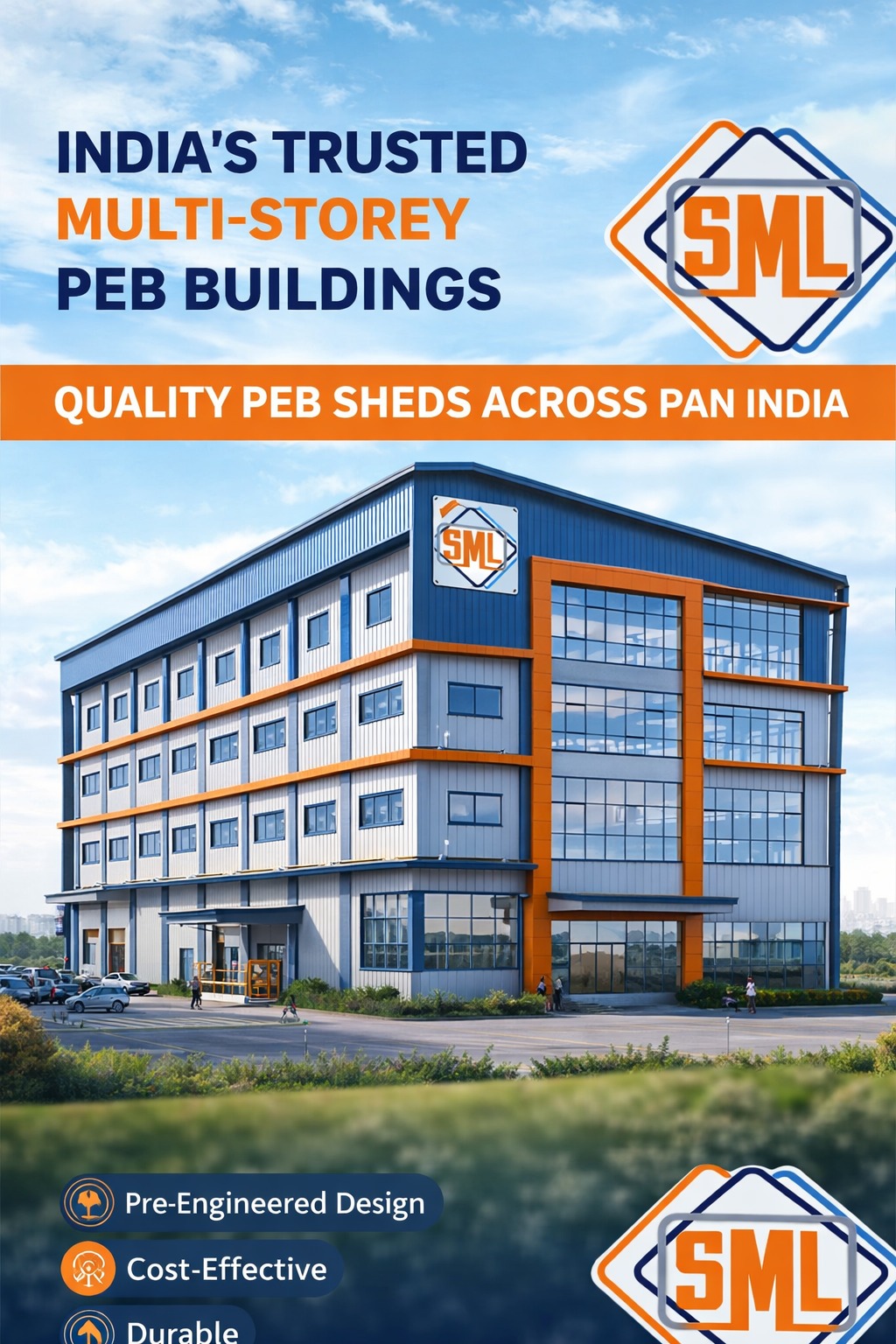
Multi-Storey PEB Buildings: The Complete Guide to Smart, Scalable Construction in India
The Indian construction industry is undergoing a major transformation. Rapid urbanization, rising land costs, faster project deadlines, and the need for sustainable infrastructure are pushing businesses to adopt smarter building technologies. One solution that has emerged as a game-changer is the Multi-Storey Pre-Engineered Building (PEB).
At Saxena Marine Tech Pvt. Ltd., we are witnessing a massive shift in how industries, logistics companies, manufacturers, and developers are planning their infrastructure. Multi-storey PEB buildings are no longer a niche solution—they are becoming the future of commercial and industrial construction in India.
This comprehensive guide will help you understand everything about multi-storey PEB buildings—from design and engineering to benefits, applications, cost savings, sustainability, and why they are the smartest investment for modern businesses.
Understanding Multi-Storey PEB Buildings
What is a Pre-Engineered Building (PEB)?
A Pre-Engineered Building is a steel structure that is designed, fabricated, and manufactured in a factory and then assembled at the project site. Every structural component is engineered with precision using advanced software and quality-controlled manufacturing processes.
Unlike traditional construction where materials are cut and assembled on site, PEB buildings follow a design-to-delivery approach, ensuring speed, accuracy, and cost optimization.
What Makes It “Multi-Storey”?
Multi-storey PEB buildings are engineered steel structures designed to support multiple floors vertically, making them suitable for:
- Industrial plants
- Warehouses
- Commercial offices
- Institutional buildings
- Logistics parks
- Business hubs
This vertical expansion capability makes PEB a powerful solution in cities where land is expensive and space optimization is essential.
Why India is Moving Towards Multi-Storey PEB Construction
India is experiencing unprecedented growth in:
- E-commerce and logistics
- Manufacturing and industrialization
- Infrastructure development
- Commercial real estate
- Urban expansion
Traditional RCC construction struggles to keep pace with the speed required in modern development. Multi-storey PEB buildings provide a faster, scalable, and cost-effective alternative.
Key drivers behind this shift include:
- Increasing land prices
- Demand for quick project completion
- Need for sustainable construction
- Expansion of warehousing and logistics
- Smart city development
Key Components of a Multi-Storey PEB Building
Understanding the components helps businesses appreciate the engineering behind PEB structures.
Primary Steel Structure
This includes columns, rafters, beams, and main frames designed to carry loads efficiently.
Secondary Structural Members
These include purlins, girts, and bracing systems that enhance stability and load distribution.
Floor Systems
Multi-storey PEB buildings include:
- Composite decks
- Steel joists
- Concrete slab systems
These provide strength and durability for heavy loads.
Roofing & Wall Cladding
Modern PEB buildings offer:
- Insulated panels
- Sandwich panels
- Metal cladding
- Architectural facades
Mezzanine & Intermediate Floors
Flexible layouts allow for office spaces, storage, and operational areas.
Top Benefits of Multi-Storey PEB Buildings
Faster Construction Time
PEB projects can be completed 30–50% faster than conventional buildings.
Why?
- Parallel manufacturing and site preparation
- Reduced on-site labour
- Pre-fabricated components
- Faster assembly
Faster completion means earlier operations and quicker ROI.
Significant Cost Savings
Businesses save money through:
- Optimized steel usage
- Reduced foundation cost
- Minimal construction waste
- Lower labour dependency
- Faster project delivery
Overall savings can reach 10–20% of total project cost.
Superior Structural Strength
PEB buildings are engineered for:
- High wind loads
- Seismic resistance
- Heavy equipment loads
- Long life span
Steel structures maintain structural integrity for decades.
Space Optimization Through Vertical Expansion
Multi-storey PEB buildings help maximize land utilization by building vertically.
Ideal for:
- Urban industrial zones
- Metro cities
- Logistics hubs
Design Flexibility & Customization
PEB buildings can be customized for:
- Floor layouts
- Facades
- Skylights
- Ventilation systems
- Future expansion
Sustainability & Green Construction
PEB buildings support eco-friendly practices:
- Recyclable steel materials
- Reduced construction waste
- Energy-efficient insulation
- Solar roof compatibility
Applications of Multi-Storey PEB Buildings
Industrial Manufacturing Units
Factories need strong floors, high load capacity, and large spaces. Multi-storey PEB buildings provide ideal industrial infrastructure.
Warehousing & Logistics
Multi-level warehouses are crucial for:
- E-commerce fulfillment centers
- Distribution hubs
- Cold storage facilities
Commercial Office Buildings
Modern glass and steel PEB offices offer:
- Attractive facades
- Flexible layouts
- Cost efficiency
Institutional & Infrastructure Projects
PEB buildings are used in:
- Schools and colleges
- Hospitals
- Transport hubs
Engineering & Design Process
Step 1: Requirement Analysis
Understanding:
- Land size
- Load requirements
- Floor count
- Usage type
Step 2: Structural Design
Using advanced software for:
- Load calculations
- Wind and seismic analysis
- Structural optimization
Step 3: Factory Fabrication
Precision manufacturing ensures:
- Quality control
- Accuracy
- Faster production
Step 4: Site Erection
Components are assembled quickly with minimal delays.
Comparing PEB vs Conventional RCC Construction
Feature | Multi-Storey PEB | RCC Construction |
Construction Speed | Very Fast | Slow |
Cost | Lower | Higher |
Expansion | Easy | Difficult |
Sustainability | High | Moderate |
Maintenance | Low | High |
Future of Multi-Storey Steel Buildings in India
With government initiatives, infrastructure development, and rising industrial demand, multi-storey PEB buildings will dominate the construction sector in the coming decade.
Industries that will benefit most:
- E-commerce
- Manufacturing
- Logistics
- Renewable energy
- Commercial real estate
Why Choose Saxena Marine Tech for Multi-Storey PEB Projects
We provide complete turnkey solutions including:
- Design & engineering
- Fabrication & supply
- Erection & project management
- Pan India execution
Our mission is to deliver durable, scalable, and cost-effective steel buildings that help businesses grow faster.
Conclusion
Multi-storey PEB buildings represent the future of modern infrastructure. They offer speed, strength, flexibility, sustainability, and long-term cost savings.
For businesses planning new facilities or expansion, investing in multi-storey PEB construction is not just smart—it’s strategic.
For any query contact us:
Frequently Asked Questions (FAQs)
- What is a multi-storey PEB building?
A steel structure designed to support multiple floors using pre-engineered components.
- Are PEB buildings suitable for offices?
Yes, they are widely used for commercial office spaces.
- How long does construction take?
Typically 30–50% faster than traditional RCC buildings.
- Are PEB buildings earthquake resistant?
Yes, they are designed to meet seismic standards.
- Can PEB buildings support heavy machinery?
Yes, floors are engineered for heavy loads.
- Are multi-storey PEB buildings cost-effective?
Yes, they reduce overall project costs by 10–20%.
- Can the building be expanded later?
Yes, PEB buildings allow easy vertical and horizontal expansion.
- Do PEB buildings require maintenance?
Very minimal maintenance is required.
- Are PEB buildings eco-friendly?
Yes, steel is recyclable and reduces construction waste.
- Can solar panels be installed?
Yes, PEB roofs are ideal for solar integration.
- Are PEB buildings durable?
Yes, they are designed for long service life.
- Can they be customized architecturally?
Yes, facades and layouts are fully customizable.
- Are PEB buildings fire resistant?
Fire protection systems can be integrated.
- Is PEB suitable for warehouses?
Yes, multi-level warehousing is a major application.
- Do PEB buildings reduce foundation cost?
Yes, lighter structures reduce foundation requirements.
- Are PEB buildings suitable across India?
Yes, they are designed for diverse climate conditions.
Build Faster. Build Smarter. Build with PEB.